Discover the Path to Mathematical Mastery
An Education That Counts
Angle \(\theta\) satisfies
\(0<\theta<90\) degrees
Angle \(\theta\) satisfies
\(\theta=90\) degrees
Angle \(\theta\) satisfies
\(90<\theta<180\) degrees
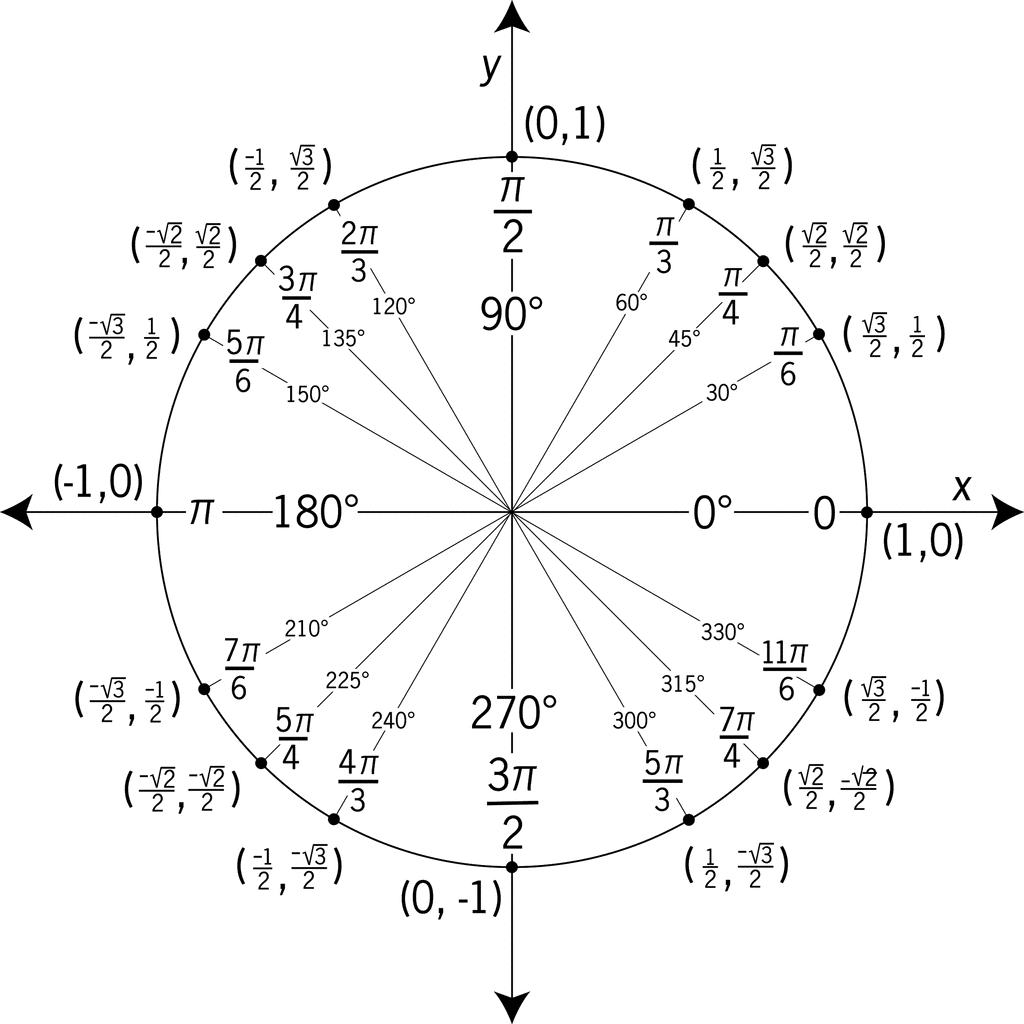
A complete rotation around a circle is \(2\pi\) radians.
To convert from Radians to Degrees use the multiplicative conversation factor.
\(\displaystyle\frac{180 \text{ degrees}}{\pi \text{ radians}}\)
A complete rotation around a circle is \(180\) degrees.
To convert from Degrees to Radians use the multiplicative conversation factor.
\(\displaystyle\frac{\pi\text{ radians}}{180\text{ degrees}}\)
| Location | \(\theta\) | \(\texttt{sin}(\theta)\) | \(\texttt{cos}(\theta)\) | \(\texttt{tan}(\theta)\) |
| x-axis | \(0\) | \(0\) | \(1\) | \(0\) |
| Quadrant 1 | \(\displaystyle\frac{\pi}{6}\) | \(\displaystyle\frac{1}{2}\) | \(\displaystyle\frac{\sqrt{3}}{2}\) | \(\displaystyle\frac{\sqrt{3}}{3}\) |
| \(\displaystyle\frac{\pi}{4}\) | \(\displaystyle\frac{\sqrt{2}}{2}\) | \(\displaystyle\frac{\sqrt{2}}{2}\) | \(\displaystyle 1\) | |
| \(\displaystyle\frac{\pi}{3}\) | \(\displaystyle\frac{\sqrt{3}}{2}\) | \(\displaystyle\frac{1}{2}\) | \(\displaystyle\sqrt{3}\) | |
| y-axis | \(\displaystyle\frac{\pi}{2}\) | \(1\) | \(0\) | \(\texttt{DNE}\) |
| Location | \(\theta\) | \(\texttt{sin}(\theta)\) | \(\texttt{cos}(\theta)\) | \(\texttt{tan}(\theta)\) |
| y-axis | \(\displaystyle\frac{\pi}{2}\) | \(1\) | \(0\) | \(\texttt{DNE}\) |
| Quadrant 2 | \(\displaystyle\frac{\pi}{3}\) | \(\displaystyle\frac{\sqrt{3}}{2}\) | \(\displaystyle-\frac{1}{2}\) | \(\displaystyle-\sqrt{3}\) |
| \(\displaystyle\frac{\pi}{4}\) | \(\displaystyle\frac{\sqrt{2}}{2}\) | \(\displaystyle-\frac{\sqrt{2}}{2}\) | \(\displaystyle-1\) | |
| \(\displaystyle\frac{\pi}{6}\) | \(\displaystyle\frac{1}{2}\) | \(\displaystyle-\frac{\sqrt{3}}{2}\) | \(\displaystyle-\frac{\sqrt{3}}{3}\) | |
| x-axis | \(\pi\) | \(0\) | \(1\) | \(0\) |
| Location | \(\theta\) | \(\texttt{sin}(\theta)\) | \(\texttt{cos}(\theta)\) | \(\texttt{tan}(\theta)\) |
| x-axis | \(\pi\) | \(0\) | \(-1\) | \(0\) |
| Quadrant 3 | \(\displaystyle\frac{7\pi}{6}\) | \(\displaystyle\frac{1}{2}\) | \(\displaystyle-\frac{\sqrt{3}}{2}\) | \(\displaystyle\frac{\sqrt{3}}{3}\) |
| \(\displaystyle\frac{5\pi}{4}\) | \(\displaystyle-\frac{\sqrt{2}}{2}\) | \(\displaystyle-\frac{\sqrt{2}}{2}\) | \(\displaystyle 1\) | |
| \(\displaystyle\frac{4\pi}{3}\) | \(\displaystyle-\frac{\sqrt{3}}{2}\) | \(\displaystyle-\frac{1}{2}\) | \(\displaystyle\sqrt{3}\) | |
| y-axis | \(\displaystyle\frac{3\pi}{2}\) | \(-1\) | \(0\) | \(\texttt{DNE}\) |
| Location | \(\theta\) | \(\texttt{sin}(\theta)\) | \(\texttt{cos}(\theta)\) | \(\texttt{tan}(\theta)\) |
| y-axis | \(\displaystyle\frac{3\pi}{2}\) | \(-1\) | \(0\) | \(\texttt{DNE}\) |
| Quadrant 4 | \(\displaystyle\frac{5\pi}{3}\) | \(\displaystyle-\frac{\sqrt{3}}{2}\) | \(\displaystyle\frac{1}{2}\) | \(\displaystyle-\sqrt{3}\) |
| \(\displaystyle\frac{7\pi}{4}\) | \(\displaystyle-\frac{\sqrt{2}}{2}\) | \(\displaystyle\frac{\sqrt{2}}{2}\) | \(\displaystyle -1\) | |
| \(\displaystyle\frac{11\pi}{6}\) | \(\displaystyle-\frac{1}{2}\) | \(\displaystyle\frac{\sqrt{3}}{2}\) | \(\displaystyle-\frac{\sqrt{3}}{3}\) | |
| x-axis | \(\displaystyle2\pi\) | \(0\) | \(1\) | \(0\) |
*Be sure to take some time to memorize these special angle values on the unit circle.